3 Responses to “Haris Pilton: Think Dubby Vol. 3 (Tribute to King Tubby)"
Oh dear. There he is again. Fya in a Babylon.
Disgust sets in! From the cover, tunes, or caption…backaway!
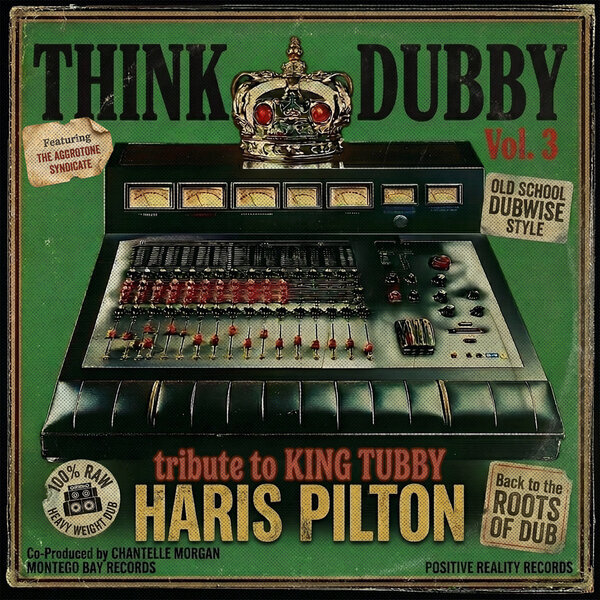
At “Think DubI didn't notice it so much on Vol. 1 and 2, but on Vol. 3, Haris Pilton has managed to bring out the sharp edges that I particularly like in earlier recordings by King Tubby, or rather, in recordings from the Tubby camp. To me, it sounds very much like the infamous "high-pass filter," which produced a sound that I—to put it mildly—didn't like at all and probably never will. And yet, I often talk about how reggae, and especially reggae, should be... Dub It should have some rough edges to avoid falling into that "reggae good vibes" and "oh, reggae is so chill" bubble. However, ever since my apprenticeship, I've been used to rough edges being at least smoothed out so you don't get hurt. The high-pass filter gives me the feeling that the rough edges have been deliberately made even sharper, so you feel like you're riding a razor's edge. In short, it's too sharp for me and it detracts from my listening pleasure. I still think the riddims are very good, and I'm complaining on very thin ice, or rather, at a very high level. It's nowhere near as bad as some of King Tubby's recordings, and certainly not as bad as so many of Bunny Lee's recordings, who is, after all, a real...
He was a "cymbal fetishist".
I should add that I can't scientifically or even substantiate any of this. It's just my personal impression of what I'm listening to, which I'm trying to describe. There are many King Tubby fans around the world who don't find it nearly as bad as I do.
Perhaps I'm being unfair to Haris Pilton, because I'm far from knowing his albums by heart, but this is the first time I've truly realized that he sometimes "takes out" the riddim, so to speak, to send the remaining instruments through the echo chamber, thus immortalizing them in interstellar space. What I also really appreciate about the DubWhat I like so much about Haris Pilton's music in general is that he lets the riddim run through more, thereby giving the Dub overall, it makes it very danceable.
Furthermore, Haris Pilton is more than just a "gym," because his music doesn't need muscles; it already has the primal power within it.
 dubblog
3 Responses to “Haris Pilton: Think Dubby Vol. 3 (Tribute to King Tubby)"
Oh dear. There he is again. Fya in a Babylon.
Disgust sets in! From the cover, tunes, or caption…backaway!
At “Think DubI didn't notice it so much on Vol. 1 and 2, but on Vol. 3, Haris Pilton has managed to bring out the sharp edges that I particularly like in earlier recordings by King Tubby, or rather, in recordings from the Tubby camp. To me, it sounds very much like the infamous "high-pass filter," which produced a sound that I—to put it mildly—didn't like at all and probably never will. And yet, I often talk about how reggae, and especially reggae, should be... Dub It should have some rough edges to avoid falling into that "reggae good vibes" and "oh, reggae is so chill" bubble. However, ever since my apprenticeship, I've been used to rough edges being at least smoothed out so you don't get hurt. The high-pass filter gives me the feeling that the rough edges have been deliberately made even sharper, so you feel like you're riding a razor's edge. In short, it's too sharp for me and it detracts from my listening pleasure. I still think the riddims are very good, and I'm complaining on very thin ice, or rather, at a very high level. It's nowhere near as bad as some of King Tubby's recordings, and certainly not as bad as so many of Bunny Lee's recordings, who is, after all, a real...
He was a "cymbal fetishist".
I should add that I can't scientifically or even substantiate any of this. It's just my personal impression of what I'm listening to, which I'm trying to describe. There are many King Tubby fans around the world who don't find it nearly as bad as I do.
Perhaps I'm being unfair to Haris Pilton, because I'm far from knowing his albums by heart, but this is the first time I've truly realized that he sometimes "takes out" the riddim, so to speak, to send the remaining instruments through the echo chamber, thus immortalizing them in interstellar space. What I also really appreciate about the DubWhat I like so much about Haris Pilton's music in general is that he lets the riddim run through more, thereby giving the Dub overall, it makes it very danceable.
Furthermore, Haris Pilton is more than just a "gym," because his music doesn't need muscles; it already has the primal power within it.
Those who feel it, know it! …………………….. lemmi